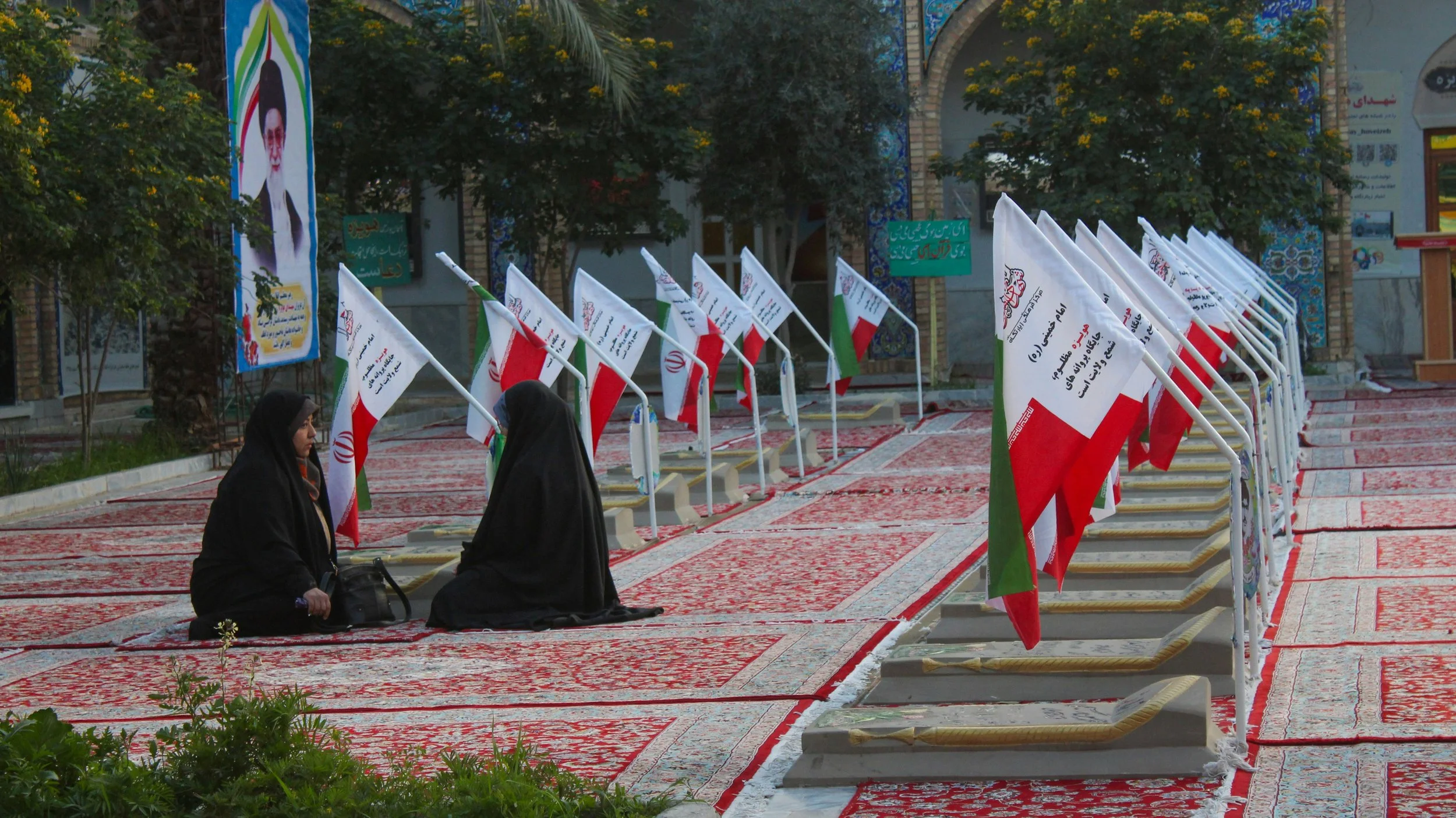
Reporting on the war in Iran requires not only bringing a keen eye to its geopolitical realities and ramifications but also a nuanced understanding of how religion shapes, and is shaped by, the conflict.
This reporting requires paying attention to both internal dynamics (e.g., how the state uses religion to justify policy and suppress diversity) and external narratives, including how religious rhetoric is mobilized abroad to offer support for, and protest, the war.
In this guide, we offer background, resources, relevant stories and expert sources to help you better cover the religion angle on the current conflict and what it might mean in the wake of the latest war in the Middle East.
Background
Iran’s religious contours are shaped by centuries of history but more recently the 1979 Islamic Revolution, when clerical leadership fused religion with state authority. The Islamic Republic of Iran it founded is a theocratic state that constitutionally embeds its interpretation of Twelver Shiʿa Islam into the country’s legal and political systems, shaping governance, laws and public life. This gives the clerical establishment broad influence over the state and country as a whole — including the laws and how they are implemented across the judiciary, educational sector and to govern public morality.
This framework influences everything from public morality codes to social services, and it is integral to understanding how the state responds to dissent and dissenters. At the same time, this official religious order exists alongside a rich tapestry of religious communities — including Sunnis, Christians, Jews, Zoroastrians and others — whose rights and freedoms are unevenly protected and often actively suppressed. Most notably, Baha’is, who are not legally recognized, face harsh persecution, including arrests and property seizures, while Christians — especially converts — are frequently prosecuted under charges that frame peaceful worship as “propaganda against the state.”
According to the latest monitoring by the U.S. Commission on International Religious Freedom (USCIRF), approximately 90–95 % of the country’s nearly 90 million people are identified as Shiʿa Muslims, with Sunni Muslims making up most of the remainder; recognized non‑Muslim minorities such as Christians, Jews and Zoroastrians make up a small fraction of the population and have limited, conditional protections under law. Non‑recognized communities — most prominently Baha’is — are denied legal safeguards and are subject to systematic discrimination and violence.
Over the past year, and prior to the 2026 U.S.-Israeli war against Iran and the killing of Supreme Leader Ali Khamenei, reports of crackdowns on religious minorities have increased. State security forces have carried out raids on homes, arrested Baha’is on broad charges as threats to national security, and aggressively prosecuted Christian converts for basic acts of worship. Authorities often frame these actions in national security language, but independent monitoring sees this as part of a broader effort to reinforce ideological conformity and suppress alternatives to the state’s religious monopoly.
This religious framework also conditions Iranian society’s response to the war. Inside Iran, state media and officials frequently invoke themes of sacrifice, resistance and divine duty drawn from their interpretation of Shiʿa tradition to buttress public support and frame the conflict within a larger moral narrative. Martyrdom — a central concept in Shiʿa thought given the killing of Imam Husayn ibn Ali at Karbala in 680 — resonates deeply when leaders or soldiers fall, bridging state objectives with religious sentiment.
The status of religious minorities, along with other minoritized populations, has deteriorated even further since the start of the 2026 war. The Iranian government has been treating its minority populations as potential internal threats, with arrests and escalating state-sponsored violence. For instance, the government has used the conflict to justify a surge in arrests among members of the Baha’i, Jewish and Christian communities.
Specifically, it has intensified property confiscations and arbitrary detentions against Baha’is; increased the number of arrests of Christian converts for “promoting Zionist Christianity;” demolished Sunni mosque foundations and arrested clerics who challenge official narratives and pressured Jewish Iranians to publicly denounce Israel, with some facing heightened risk of being charged with espionage. Furthermore, reports suggest the conditions of religious prisoners of conscience have deteriorated given abandoned prison management, severe deprivation and a surge in executions.
Externally, the war has also become entangled with religious narratives in the U.S. and Israel. In both, elements of religious framing have emerged that cast the conflict in civilizational or prophetic terms, complicating perceptions and policy debates, as well as an end to the war.
Some U.S. military personnel have reported that commanders used biblical end‑times rhetoric — drawn from parts of Christian evangelical tradition — to frame the conflict as divinely sanctioned, prompting concerns about the mixing of religious ideology with military policy. Likewise, commentators note that political leaders in both Washington and Jerusalem sometimes employ civilizational language — framing the confrontation as a clash between religious identities — to mobilize support, simplify complex geopolitical causes and appeal to domestic constituencies such as Christian Zionists, who believe “the strengthening of the state of Israel will ultimately lead to the erection of the Temple in Jerusalem and hasten the arrival of the day of judgement.”
All this shapes how the war’s religious dimensions are reported: the theocratic nature of the Iranian state, the vulnerability of minority faith communities and dissenting members of the majority as well as the global politics of faith and war are intertwined in ways that extend far beyond the battlefield.