• Home
  • About
    • Overview
    • Engaged Spirituality
    • Borícua Muslims
    • The Muslims of Latin America and the Caribbean
  • Contact
Menu

KEN CHITWOOD

Religion | Reporting | Public Theology
  • Home
  • About
  • Books
    • Overview
    • Engaged Spirituality
    • Borícua Muslims
    • The Muslims of Latin America and the Caribbean
  • Contact
“The person who knows only one religion, knows none”
— Max Müller

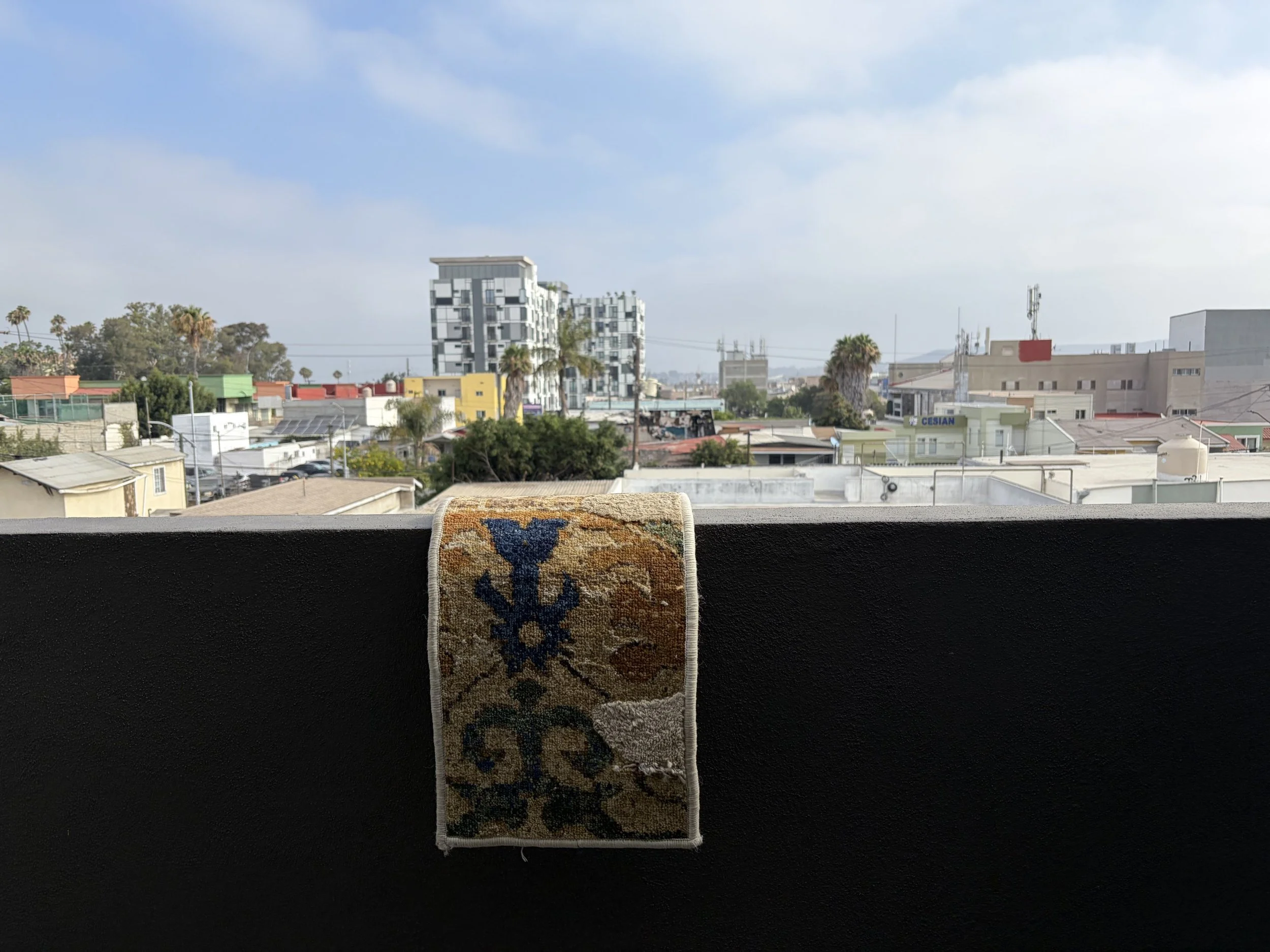
The carpet fragment with a view to the U.S./Mexico border in Tijuana. PHOTO: Ken Chitwood

“I Should’ve Taken More Photos”: On Fragments, Fieldwork, and the Things We Pick Up and Leave Behind

September 16, 2026

At a shelter in Tijuana, a young man from Ghana told me he wished he had taken more photos.

He mentioned it when I asked if he had wisdom for others on the road. As we talked about the months it had taken him to reach the U.S./Mexico border — the buses, the boats, the walking and hitchhiking, the people he had met and then lost along the way, some to different routes, some to detention, some, he suspected, to death — he said he wished he had recorded the experience, to remember it, good, bad, and in-between.

He wanted to remember the faces. He wanted proof that others had existed alongside, that the journey had been shared rather than solitary. What he had instead of photos was memory — porous, softening at the edges — and the nagging sense that he should have documented more, captured more, held on to more, before the journey took it from him.

Since returning from the field, I’ve thought about that wisdom often. I was in Tijuana as part of research on Muslim migrants across the Caribbean and Latin America, in places like Bridgetown, Barbados, where small but resilient Muslim communities have grown out of decades of trade, marriage, and movement, and in the shifting, improvised landscapes of transit through Mexico, where Muslims from West Africa, Southwest Asia, the Caucasus, and elsewhere increasingly find themselves alongside Haitians, Venezuelans, and others on similar routes north.

These are not necessarily the geographies people expect when they picture Muslim life in movement. That story is usually told through Europe, through the Mediterranean, through more familiar maps of displacement in other places.

But the lives I have followed unsettle those maps. They show devotion practiced in borrowed rooms and courtyards, prayer times kept while waiting on buses, halal meals improvised from what is available, small communities of faith stitched together from people who share almost nothing except the road and the God they are praying to along it.

The stories people share with me during our interviews are rarely complete. They are fragments. A photo of a mosque in a city they passed through in Brazil, a voice note from a cousin left behind in West Africa, a name half-remembered because the person who introduced them is no longer reachable in detention in Arizona. People build and make sense of their lives in pieces, and they lose some of those pieces as they build them, and both things happen at once, for as long as the journey lasts – and beyond.

During this same period of fieldwork, I was carrying a fragment of the Museum for Islamic Art's dragon carpet — a small woven piece, cut from a handwoven doppelgänger of the museum's seventeenth-century Caucasian carpet, sent out into the world as one of a hundred such fragments meant to travel, gather stories, and eventually return to Berlin to be reassembled into a single whole again.

I photographed it constantly as I went: laid out on a guesthouse floor in Bridgetown, propped against the border wall, held up against the light in half a dozen cities across the region and along the way. Those photos were meant to be part of the record, my own small contribution to the fragment's journey, evidence of where it had been and who had seen it.

And then my phone was stolen, and a corrupted backup file meant that most of my photos were gone. What I was left with, in the end, was the carpet fragment itself and the things it had picked up along the way — discoloration from the sun, stains from its dip into the Caribbean Sea,

Continue the journey
In Religion, Religion and Culture, Travel Tags Cultural X Collabs, Dragon Carpet, Immigration, Migrant stories, Fieldwork, Anthropology, Cultural anthropology, Tijuana, Museum für Islamische Kunst Berlin, Pergamonmuseum
Comment

Religion, Immigration and the 2024 Elections

September 9, 2024

Over the last six months, I’ve been covering religion and immigration for Sojourners Magazine.

I traveled to Tijuana, Mexico, Lampedusa, Italy, southern Arizona and downtown Los Angeles to hear from migrants making their way. I heard from Muslim aid workers on the front lines providing sanctuary and nuns serving the vulnerable asylum seekers living on the streets of Skid Row. I sat with mothers weeping over their children and praying for safe passage at a cemetery just meters from the bollard-steel border wall that rips through the Sonoran wilderness like a rust-colored wound. 

In my latest for ReligionLink and as part of my “What You Missed Without Religion Class” series at Patheos, I reflect on what you need to know about faith and immigration ahead of the 2024 elections.

A PRIMER ON RELIGION AND IMMIGRATION
Learn more at Patheos
In Religion and Culture, Religion News, ReligionLink, Religious Literacy Tags Religion, Religion and immigration, Immigration, People on the move, Migrants, Asylum seekers, ReligionLink, Patheos, What you missed without religion class, Tijuana, Southern Arizona, Los Angeles, Lampedusa, Faith and Immigration, Sojourners
1 Comment

The blue dome of Albergue Assabil stands out in the Tijuana skyline. PHOTO: Ken Chitwood

At the border, a shelter for -- and by -- women

September 2, 2024

Anyone crossing the U.S.-Mexico border faces a journey fraught with violence and danger.

But for women and children, that journey is even more treacherous. Not only are many fleeing violence at home — including gender-based violence — they also experience higher rates of violence en route. Torture, mutilation, sexual violence, femicide,disappearances, and additional health complications are common occurrences for female migrants making their way north.

That danger is amplified for the thousands of girls living in makeshift camps and tent cities along the U.S.-Mexico border without protection or accompanying support. According to the Washington, D.C.-based Kids In Need of Defense, “[u]naccompanied children are especially vulnerable to sexual violence, human trafficking, and exploitation by cartels and other criminal groups.”

Over the last few years, a group of Muslim women has stepped in to meet their needs in unique ways. Albergue Assabil (“the Shelter of the Path”), the first Muslim shelter along the U.S.-Mexico border, has been in operation since June 2022 under the leadership of Sonia Tinoco García, founder and president of the Latina Muslim Foundation. According to staff, the shelter served nearly 3,000 migrants in its first two years of operation. Many of those migrants have been women, attracted to the shelter because of its separate men’s and women’s facilities and the fact that Albergue Assabil is a female-led shelter.

And it’s not only Muslim women finding sanctuary under the shade of the shelter’s blue dome; there have also been other female immigrants looking to García and her team for assistance as they make the perilous journey north.

Read the full story at Sojourners
In Religion, Religion and Culture, Religion News, Travel Tags Tijuana, Mexico, U.S./Mexico border, Border, Immigration, Migrants, Asylum seekers, Muslims in Mexico, Muslim migrants to the U.S., Muslim migrants, Latina Muslims, Latina Muslim Foundation, Albergue Assabil, Shelter for Muslim migrants, Shelter of the path
Comment
Latest Writing RSS

Fresh Tweets

Tweets by kchitwood

Latest Writing RSS

RELIGION | REPORTING | PUBLIC THEOLOGY