Every December, around the time I begin searching for the box of Advent candles and untangling the lights we swore we’d store neatly last year, I also make my way through digital holiday greetings. And Tuesday, as I whipped through a fresh batch of e-mails, I came across one from my dear friend Mohammed.
The subject line? “Merry Christmas.”
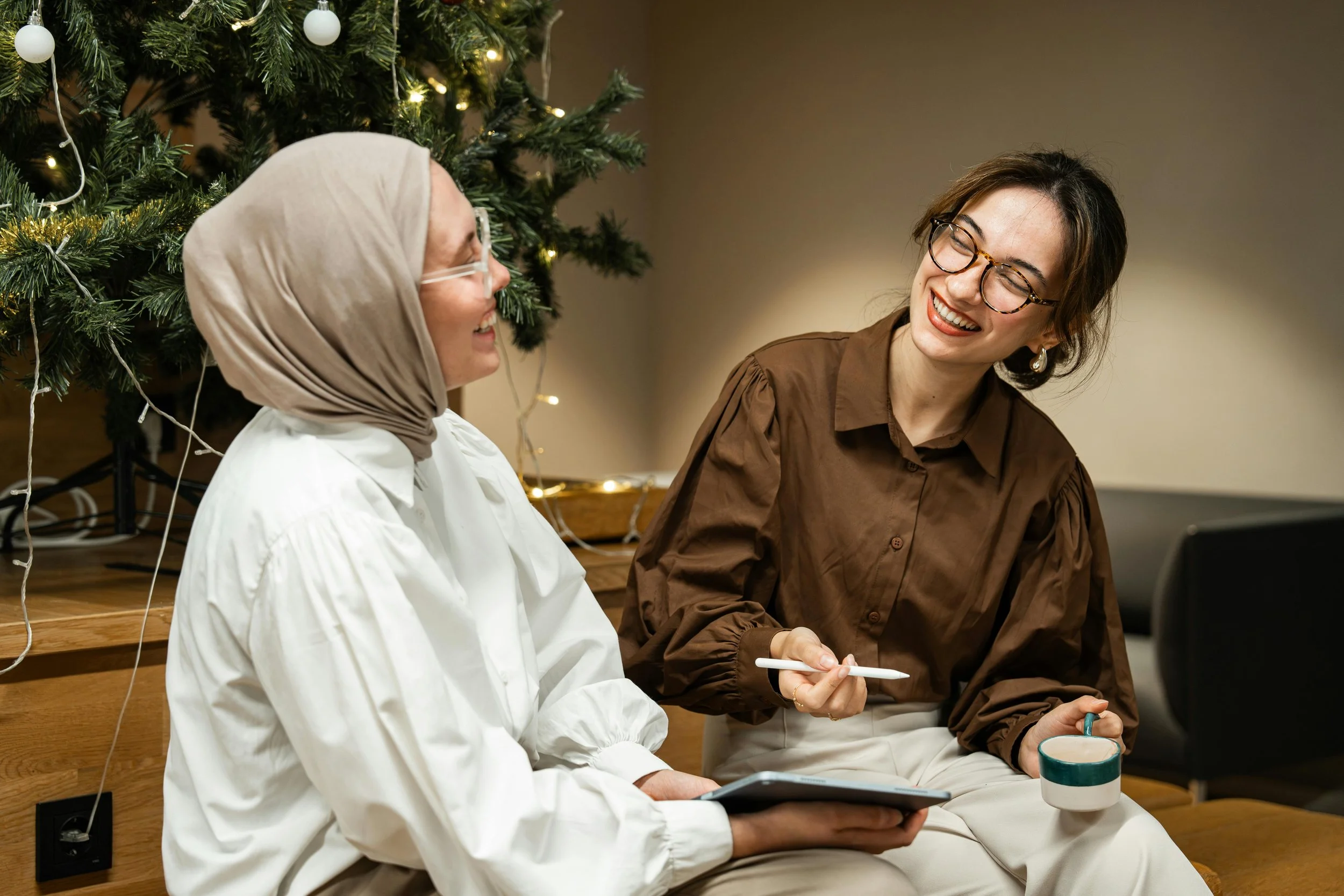
His is not the only Christmas greeting I’ll receive from Muslims this year. In fact, numerous contacts and colleagues from Cairo, London, Dubai, Bridgetown, and Minneapolis will send me seasonal salutations for a holiday they themselves will not celebrate…at least not religiously.
Some hearing of these exchanges might tilt their head in inquiry: Why would Muslims wish me a Merry Christmas? Isn’t the holiday distinctly Christian, defined by the celebration of Jesus’ birth — a figure Muslims understand differently than Christians?
Those questions are precisely what makes the greeting worth offering, and worth reflecting on.
A Shared Story, Told in Different Ways
Muslims do not celebrate Christmas as a religious holiday. But they do honor the birth of Jesus.
The Quran devotes an entire chapter (or surah) to Mary (Maryam), recounting her labor pains, her fear and isolation, the miraculous birth of her son. Jesus (Isa), son of Mary, is mentioned a total of 25 times in the Quran, revered as a righteous prophet, a messenger, a “sign for humanity” (Q 19:21; 21:91), and as the “Spirit from God.” (Q 4:171)
While the Quran denies Christian beliefs about his crucifixion and resurrection (and surely, this accounts for major differences between the two traditions), Muslims believe that Jesus was conceived miraculously (Q 3:45). So, even if Muslims do not mark December 25 with a liturgical celebration, the story Christians celebrate is not foreign to them. It is part of their sacred narrative. And this means that Jesus — and by extension Christmas — can act, in the words of Jordan Denari Duffner and in the spirit of her book Finding Jesus Among Muslims, as a “bridge rather than a boundary” between Christians and Muslims.
A Very Muslim Christmas?
That bridge can be particularly visible in December, when the Nativity story is central to Christian worship, and when Muslim reverence for Jesus and Mary quietly parallels that of Christians.
For example, Christmas in Egypt is a vibrant national event, especially among Coptic Christians who mark the holiday on January 7th. The season is marked, however, by both Muslim and Coptic Christian communities with decorations, festive meals and gifts. Muslims widely participate by exchanging greetings, visiting Christian friends and generally enjoying the festive atmosphere in decorated malls and public spaces, viewing it as a shared cultural holiday.
In Bethlehem, Muslims walk through Manger Square during the tree-lighting ceremony, standing shoulder-to-shoulder with Christians. One friend of mine made a special trip back to Bethlehem to join her Christian neighbors in the celebrations, particularly important this year as the tree-lighting returned for the first time since December 2022 and the start of the War in Gaza 10 months later. Attending these events becomes a shared act of memory and solidarity, she said, with Muslims, Christians, and others in Palestine recalling how the original Nativity narrative mirrors Palestinian realities of occupation, displacement and struggle, featuring refugees (Mary, Joseph, Jesus), an oppressive empire (Rome) and massacres (of innocents), finding resonance in modern experiences in Bethlehem and Gaza, where Jesus would be “born among the oppressed.”
In Barbados, Muslim families will join neighbors for festive meals, decorate their houses with lights and serve together in the community. And thanks to the long history of Muslim professionals and businesspeople from Bengal and Gujarat in the Eastern Caribbean, they also serve as essential suppliers for a festive Bajan tradition: refreshing house decor with buying new curtains from stores like Abed’s on Swan St. In a sermon (khutbah) during the holiday season in 2024, an imam advised Muslims to not get carried away but encouraged them to remember the true wisdom (hikma) of the season: that Isa’s miraculous birth shows the power and might of Allah.
Recently, on a trip to Dearborn, Michigan, which has a significant Muslim population, I was reminded of how much locals love the holiday. A nativity scene is proudly displayed in its Peace Park and at City Hall, across the street from the Arab American National Museum. Festive displays, from Santa and reindeer to Christmas trees and more, can be found in restaurants, salon and other local businesses across town.
One can find examples from numerous contexts, from Britain to Uzbekistan, Indonesia to Kenya, where Muslims engage with Christmas in ways that revolve around the season’s jolly vibes, personal relationships, shared ritual meals of lamb, chicken or biryani, the giving of small gifts to friends, neighbors, or coworkers, volunteering, or enjoying the lights, music, and markets.
From Suspicion to Hospitality
Of course, Muslims themselves navigate Christmas in diverse ways. Some embrace the season fully. Others participate selectively, enjoying the warmth of the holidays while staying clear of religious rituals. Still others avoid the season altogether, with an eye to holding firmly to a distinct, and countercultural, religious identity.
And crucially, as the imam in Barbados reminded his community, participation remains cultural, not theological. Muslims maintain clear boundaries around worship, avoiding practices that conflict with Islamic teachings about Jesus’ divine status.
This diversity is not evidence of confusion but a reminder that Islam, like Christianity and other religions, is not monolithic. It is a global, textured, and differently-lived tradition in Cairo and in London, in Tashkent and in Bridgetown.
But the shared reverence of Jesus can create space, perhaps unexpected for some, for common ground. Seeing it as such, Christmas becomes not a point of contention, but a season in which Christians and Muslims can adopt a “hermeneutic of hospitality” toward one another, assuming goodwill rather than suspicion. Through this lens, Muslims’ participation in Christmas is not a religious endorsement but a sign of belonging, an expression of what Duffner calls the “lived reality of interfaith friendship.”
One of Duffner’s most challenging insights, however, is that fear often shapes Christian attitudes toward Muslims more than any theology of hospitality. Fear creates boundaries where God invites connection. Fear distorts our ability to see Muslims’ goodwill for what it is. Fear makes us suspicious of greetings that might otherwise deepen friendship. Her antidote is simple but demanding. It is to adopt a posture of generosity, to listen before judging, to welcome rather than withdraw.
Why I Wish My Muslim Friends a Merry Christmas
Christmas, from my perspective as a Christian, embodies a message of radical, divine hospitality, with God coming near in vulnerability and offering hope to the marginalized and oppressed. In turn, I believe the holiday invites, and challenges, Christians to embrace the season as a powerful moment to practice those very virtues.
So yes, when my Muslim friends send me Christmas greetings, I send them back. Not because we believe the same things about Jesus. We don’t. But because the season’s themes of charity, generosity, hospitality and a hoped-toward, longed-for peace, resonate across our traditions. And because many Muslims, in their own way, already participate in the festive rhythms December brings.
Perhaps the most surprising gift of Christmas, as Duffner reminds us, is that when my Muslim friends wish me a Merry Christmas, I find Jesus among them — not as a point of division, but as a bridge of goodwill, reverence and shared humanity.
And that, I believe, is worth celebrating.