• Home
  • About
    • Overview
    • Borícua Muslims
    • Engaged Spirituality
    • The Muslims of Latin America and the Caribbean
  • Contact
Menu

KEN CHITWOOD

Religion | Reporting | Public Theology
  • Home
  • About
  • Books
    • Overview
    • Borícua Muslims
    • Engaged Spirituality
    • The Muslims of Latin America and the Caribbean
  • Contact
“The person who knows only one religion, knows none”
— Max Müller

PHOTO: Courtesy Yosh Ginsu on Unsplash.

Apocalypse now? When religion and natural disasters collide

June 6, 2022

As the Atlantic hurricane season begins, meteorologists are watching the Gulf of Mexico with increasing concern. A current of warm, tropical water known as the Loop Current is causing forecasters to fear “monster hurricanes” and a generally intense tropical storm season.

Hurricane Katrina, which went on to famously devastate large swaths of Louisiana and Mississippi, including New Orleans, crossed just such a Loop Current before making its harrowing landfall in 2005.

Extreme weather events like Katrina, climate convulsions and other natural disasters such as fires, earthquakes or tornadoes have inspired a range of religious reactions from the fearful or affected faithful. 

Some interpret them as a form of divine retribution and look for scapegoats upon which to place the blame. Others turn to religion as a form of “positive religious coping,” taking comfort in a higher power. Still others spring to action, providing critical support in the aftermath or offering prophetic hope for the future. 

With the hurricane and tornado seasons already upon us, post-summer wildfires looming on the horizon, global famine forecasts and potentially cataclysmic climate instability to come in the near future, this edition of ReligionLink explores the fascinating and often unsettling connection between natural disasters and religion.

Background

Experiencing something between sublime terror and numinous indescribability, when humans come face-to-face with volcanic eruptions, floods, earthquakes or epidemics they often seek to explain their upturned worlds in religious terms. 

Examining Americans’ experience with tornadoes over the years, historian Peter J. Thuesen wrote that reactions range between abject fear and awestruck fascination. “In the tornado, Americans experience something that is at once culturally peculiar and religiously primal,” he wrote. Exposing them to mysteries “above and beyond themselves,” the tornado whips up a “vortex of theodicy and the broader question of whether there is purpose or chaos in the universe.” 

Likewise, historian Philip Jenkins said that time and again, the languages of apocalypse, persecution and judgment have been used to understand climate catastrophes. Looking back over the long term, Jenkins wrote that disasters and climate change often result in “far-reaching changes in the nature of religion and spirituality.” 

Astute religion newswriters have taken notice. Given the increasing intensity of natural disasters brought on by changes in climate conditions and the ominous threat of other cataclysms always a possibility, stories about the intersections between natural disasters and religion are featuring more and more in our reporting.

Although religion is not “the only aspect of human affairs that is transformed during climate-driven disasters,” Jenkins wrote, “it is a very significant one, especially because this has so often been the primary means through which human beings have interpreted the world they see around them.” 

Taking a look at the resources available through the link below, these stories chronicle a mix of terror, trembling and spiritual searching. They feature narratives of renewed passion and inspiring commitment, scapegoating and persecution, apocalyptic expectations and mystical interpretations. Above all, they show how the convergence of faith and disaster is an area ripe for more nuanced, in-depth religion reporting.
Learn more
In Religion, Religion and Culture, Religion News, ReligionLink, Religious Studies Tags religion and natural disaster, religion and nature, Climate Change, tornado, hurricane, earthquake, fire, natural disasters
Comment

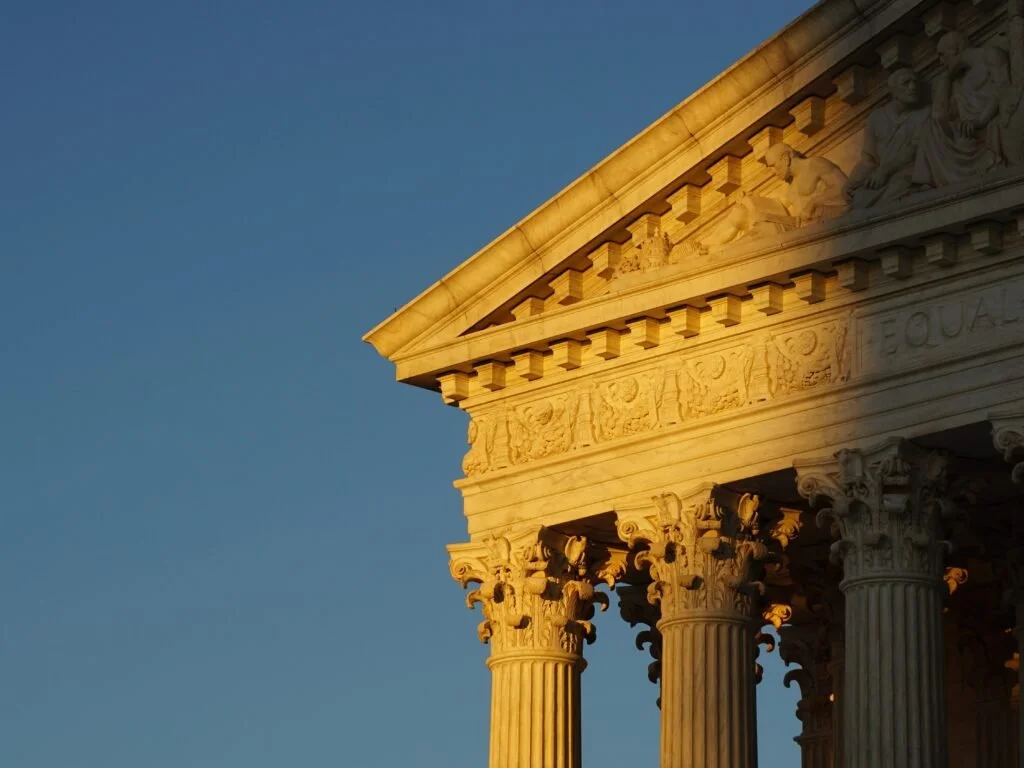
Image via Unsplash.

Religion on the docket: U.S. Supreme Court decides on cases with religious ramifications

May 3, 2022

Perhaps NPR’s Nina Totenberg put it best when she said the docket for the 2021-2022 U.S. Supreme Court term is “a humdinger with major cases involving the biggest social issues of the day.”

With a notably altered composition after the addition of three Trump appointees, the court now features six reliably conservative members. With that makeup, SCOTUS is set to decide on significant social controversies related to abortion, the separation of church and state, government surveillance and normative clarity around the scope of free expression. 

The news cycle on these cases started back in October as oral arguments began and three decisions were already issued. The churn of news is picking back up again as some cases are just now being argued and other rulings are handed down. 

Just as this edition of ReligionLink was about to go to press, the decision on Shurtleff v. Boston came out. Then, quite dramatically a draft opinion from Justice Samuel Alito was leaked to Politico, wherein he writes that the 1973 Roe v Wade decision legalizing abortion is “egregiously wrong.” The leak is unprecedented and if the draft is issued as a majority ruling, it would overturn the constitutional right to abortion in the U.S.

The latest edition of ReligionLink will get you up to speed with background explainers, resources and experts for covering the most relevant, religion-related cases the Supreme Court is set to decide on this term — or for which it already issued judgment.

Read more
In Religion, ReligionLink, Religion News, Religion and Culture, Religious Literacy Tags ReligionLink, Religion news, SCOTUS, U.S. Supreme Court, Roe v. Wade, Shurtleff v. Boston, Carson v. Makin, Kennedy v. Bremerton School District
Comment

This ain't your mama's paganism: understanding modern witchcraft, nature religions and ‘neopaganism’

April 5, 2022

As part of sweeping transformations in American religion and renewed interest in New Age spiritualities, modern paganism is tapping into a deep desire for self-empowerment, social engagement and reconnection with the natural world. 

Inspired by, or derived from, historical pagan and nature religions, modern paganism is an undeniably broad, collective category that covers a diverse range of groups that can differ greatly in belief and practice.

While Wicca and astrology have enjoyed a certain popularity for several decades, a wave of new publications has highlighted how personalized spiritual practices, home-brewed magic and shamanistic self-discovery are now enjoying their own renaissance. 

The latest edition of ReligionLink explores this new “neopaganism,” what some are calling a broader “re-paganization of religion.”

Learn more
In Religion and Culture, Religion News, ReligionLink, Religious Literacy Tags Paganism, Modern paganism, ReligionLink, Religion News Foundation, Religion News, Re-paganization of religion, Pagan religion, Wicca, Witchcraft, Tarot, Ashatru, Norse Reconstructionism, New Age, Heather Greene, The Wild Hunt
Comment

As Russia invades Ukraine, reporters explore religion's role in the conflict. (PHOTO: ReligionLink via Unsplash)

War in Ukraine: covering the conflict's religious contours

March 1, 2022

Religion often plays a role in violent conflicts. Entangled with ethno-national, economic and territorial issues, religious actors, leaders and institutions can exacerbate and ameliorate both the causes and course of a conflict. While some religious actors provide care and appeal for peace, others contribute to the brutality and provide faith-filled fuel to already tenacious confrontations.

The warfare currently engulfing Ukraine is no exception. Religion played a role as the specter of Russian invasion grew over the last several years. Now, after Russian forces began their aggressive assault on Feb. 24, 2022, religious communities within Ukraine, Russia and across the globe are responding.

“While the secular media tries to guess Vladimir Putin’s motives in Ukraine, one important aspect of the current situation has gone largely ignored: religion.”
— Diana Butler Bass, Religion News Service

The latest edition of ReligionLink gives you a rundown of all the headlines, experts, and background research on the religious contours of a war whose impacts will reverberate around the world.

Read more about religion's role in the war
In Religion, Religion and Culture, Religion News, ReligionLink Tags Ukraine, War, Russia, Russian Orthodoxy, Judaism, Christianity, Eastern Orthodoxy, Orthodoxy, Orthodox Church, Greek Orthodox, Kyiv, Kiev, Religion in Ukraine, Religion in Russia, Vladimir Putin, Religion, Religion and conflict
1 Comment

Photo: Marcel Melus via Unsplash.

Who are the exvangelicals?

February 8, 2022

Coined by Blake Chastain in 2016, the term “exvangelical” — or “exvie” — has come to encompass a wide range of individuals who have left evangelicalism, especially white evangelical churches in the U.S. 

Skeptical of institutions and unimpressed with status quo American Christianity, some have turned their back on religion. Others actively campaign against what they see as its abuses. Still others adopt more progressive versions of Christianity or simply do not self-identify as “evangelical” any longer, opting instead to go on a quest of self-discovery and deconstruction. Through hashtags such as #emptythepews, popular TikTok channels and a range of new platforms and publications, they are leaving loud, speaking out against evangelicalism on matters of politics, gender and race.

The latest edition of ReligionLink provides you with a range of resources and potential sources to understand how American Christianity’s traumas and political entanglements have triggered a crisis of faith for many.

Read the latest religionlink here
In Religion, ReligionLink, Religion News, Religion and Culture, Religious Literacy, Church Ministry Tags ReligionLink, Exvangelicals, American evangelicalism, American evangelicals, White evangelicals, Racism, Exvies, Blake Chastain, #emptythepews
1 Comment
← Newer Posts
Latest Writing RSS

Fresh Tweets

Tweets by kchitwood

Latest Writing RSS

RELIGION | REPORTING | PUBLIC THEOLOGY