"Brother, where are you from?"
Clarifying I was not Muslim, just visiting, the henna-bearded attendant at the Brick Lane Jamme Masjid welcomed me inside between 'asr and maghrib prayers.
Inside the red-brick building, I sat on the royal blue carpet and spoke with a delivery driver who had just finished praying. We compared notes on Christianity and Islam. He invited me upstairs to the overflow prayer room used on Fridays, when more than 3,000 people can fill the mosque. From the gallery, I looked down toward the qiblah marking the direction of Mecca.
"This used to be a synagogue," he told me. "Before that, a church."
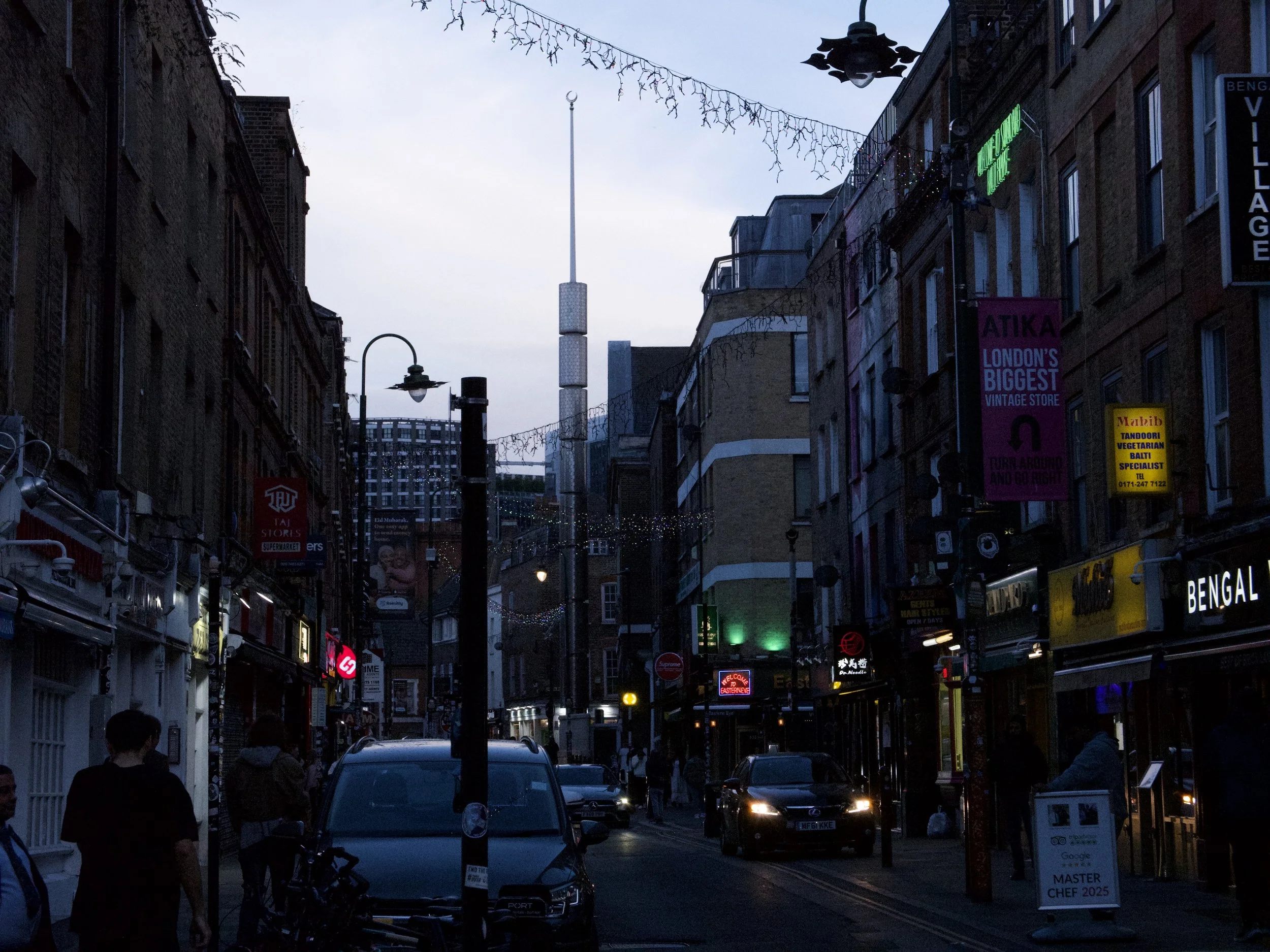
We talked about that layered history as we walked back down. Before I left, he added me to the mosque's WhatsApp group. Outside, the late afternoon had turned gray and wet. From across the street, I looked back across the busy Brick Lane to the stone slab set into the masjid'swall, which bore a Latin sundial inscription Umbra sumus(we are shadows), a reminder of how briefly we pass through this world.
Heading toward a Bangladeshi curry house, I thought about the phrase in relation to the building's history and to the politics of difference in Britain today.
The Brick Lane Church/Synagogue/Mosque
The building at 59 Brick Lane in London's East End has been shaped by seasons of immigration that brought various communities to East London's Spitalfields area. Each successive community passed through, left its mark on the neighborhood, and moved on, handing its spaces to and markets to the next newcomers.
Such is the case for what is today the Brick Lane Mosque.
Originally constructed in 1743 as a Huguenot chapel la Neuve Eglise ("The New Church"), it sheltered French Protestant refugees fleeing Catholic persecution across the Channel. In 1809, it changed hands again, becoming a Wesleyan chapel. Known as The Jews' Chapel, it was rented by the London Society for Promoting Christianity Amongst the Jews, an organization now known as the Church's Ministry Among Jewish People, which was trying to make inroads among the impoverished Jewish immigrants in East London. From 1819, the building became a Methodist chapel before, ironically, in 1891 it was taken over by a community the earlier missionaries were trying to reach.
Escaping pogroms and antisemitic violence in Russia and Central Europe, a group of Lithuanian Orthodox Jews known as the Mahzikei Hadas ("Strengtheners of the Faith"), acquired the building and made it Spitalfields Great Synagogue in 1897. Working in the area's textile industry, the Jewish community established a strong base in Spitalfields, using the synagogue from 1898 to 1973, when it relocated to the affluent, suburban Golders Green area.
Its most recent transformation came in 1976, when the building was reopened as the Brick Lane Jamme Masjid.
In the decades after the Second World War, Spitalfields and Brick Lane became home to a growing Bangladeshi community, many of whom had migrated from the Sylhet region in search of economic opportunity. Like earlier groups, Bangladeshi migrants arrived seeking work, often in textiles, sometimes in businesses once owned by Jews. As the community grew, so did the need for a central place of worship. Today, the mosque serves one of the largest Bangladeshi Muslim populations in the UK.
The Uses and Limits of Convivencia
In Muslim Europe, Tharik Hussain points to the mosque as a living monument to convivencia, or a shared life built through everyday proximity, of communities not merely tolerating one another but, building by building, street by street, shop by shop, making something shared and sacred out of everyday interactions in London's East End. The term, popularized by Américo Castro, has come to signify anything from pragmatic coexistence to an idealized vision of interfaith harmony in medieval Spain.
Writers like María Rosa Menocal helped cement that ideal, describing al-Andalus as a golden age of Jewish, Christian, and Muslim flourishing. The story has endured because it offers a compelling counterpoint to present-day polarization, a past in which difference did not fracture society. And it is a powerful story, producing genuine inspiration in popular memory and interfaith imagination.
Recent scholarship, however, has challenged these romanticized myths, emphasizing conflict, asymmetry and the contingent nature of coexistence.
Scholars such as Aaron Hughes argue that the "golden age" is frequently retrofitted to modern interfaith aspirations rather than based on concrete historical realities. Historian Mark T. Abate goes further, calling convivencia an "amorphous, simplistic, anachronistic" myth so overused and over-moralized that it risks obscuring more than it reveals.
David Nirenberg argued that violence was not an aberration from convivencia but a central and systematic feature of it. Medieval societies managed difference through systems that combined everyday proximity with hierarchies of power. The dhimmi system, for example, allowed Jews and Christians to live under Muslim rule but within defined limits. Forced conversions, episodic violence, legal discrimination, and cycles of expulsion were woven through periods of intellectual and cultural exchange.
Nirenberg thus encourages us to rethink convivencia not as harmony but as "structured conflict," a daily negotiation of diversity and difference shaped by power and socio-political hierarchies — a pattern of interaction shaped by both cooperation and conflict.
Generative Frictions
The day before I visited the Brick Lane Mosque, I wandered through Trafalgar Square. That trajectory took me straight into the midst of far-right figure Tommy Robinson's "Unite the Kingdom" rally. Drunken revelers with flags in one hand and beers in the other, clean cut youth holding wooden crosses, and a bulldog dressed in the Union Jack strolled past me as I skirted the edge of the throng before bumping into a pair of young, Muslim women who were lingering and staring with a look on their faces that expressed disgust, worry and "what the hell went wrong?!" energy all at once.
Just around the corner, another crowd was gathering to remember Nakba Day, which commemorates the forced displacement of people from Palestine in 1948, and to counter the energy or Robinson's rally.
In my recent reporting on British Muslims, I've found more such political participation and civic engagement than in previous decades. At the same time, there is heightened marginalization and rising anti-Muslim hostility. Data from Tell MAMA recorded over 6,000 cases of anti-Muslim hate in 2025 alone. That same year, most prominently, far-right marches moved through neighborhoods with large Muslim populations, leaving residents questioning their place in the national story.
And yet, from Birmingham's Sparkbrook to South Manchester, East London to Leicester, I've found mosque communities running food banks where 80 percent of recipients were not Muslim, local imams navigating tensions between foreign policy and community safety, Muslim mayors and councillors doing the grinding work of local democracy — creating, as former Solihull Mayor Shahin Ashraf put it, "democratic conversations where everyone is at the table."
Rethinking Conflict
This is not the gleaming harmony of a romanticized convivencia.
But my work reporting on interfaith organizations across different regions tells me it is more honest and just may ultimately prove more durable. The aim, I have found, is rarely the elimination of conflict, but its transformation.
This is convivencia with conflict, you might say, where generative frictions between people of differing traditions is stewarded as a practice rather than a problem. To do so requires giving up the apophatic fantasy that harmony means the absence of tension and accepting that harmony is something you make with friction, not despite it.
Difference does not dissolve when people share a street, a city or a conversation. Often, it can come into sharpened focus as we live life-on-life and discuss some of the most difficult questions the world, the divine and the fate of everyone who ever lived. The question is not whether frictions will arise (they definitely do) but whether we have the relationships, institutions and imagination to steer them in a constructive direction.
Some forms of conflict close down possibility. They harden boundaries and reduce future contact. Others, though uncomfortable, expand the capacity to remain in relation across difference.
In this sense, the romantic version of convivencia is not only inaccurate but counterproductive. It sets an unrealistic benchmark that collapses under the pressure of reality. And when conflict inevitably emerges, the model fails.
A more lasting approach, perhaps, accepts conflict as intrinsic to life together. But it asks how it can be directed rather than denied.
Back on Brick Lane
The history of 59 Brick Lane is not a seamless story of tolerance — though it may first appear so. It is a sequence of occupations shaped by migration, economics and shifting power. Each community adapted the space to its needs. Each, in time, moved or was displaced.
The building endures, not as a symbol of static harmony, but a record of continual renegotiation.
Which brings me back to Umbra sumus. The inscription underscores this impermanence, but also a sense of continuity. People pass through, structures remain, carrying traces of prior lives.
If Brick Lane and the wider British context in this moment have a lesson to teach here, it is not that difference can be resolved once and for all. It is that it must be managed repeatedly, under changing conditions.
Across contexts — from medieval Spain to contemporary Britain — plural societies have relied on institutions that can hold tension without letting it escalate. The question for each is less how to avoid conflict and more how to build forms of shared life that can withstand it.
If we are shadows, then the ethical question is not how to avoid conflict, but to ask: what kinds of institutions, habits, everyday rhythms and yes, even buildings, can hold disagreement without letting it become destructive? What kinds of practices allow disagreement without collapse? What institutions can absorb pressure without breaking? What habits enable people to remain in relation despite deep difference?
These are maybe less inspiring than the dream of perfect harmony. But they are, in the end, more useful in the time we have together.