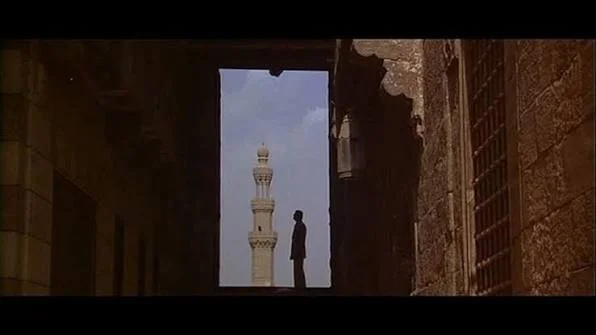
The scene opens with a sonorous call to prayer (adhan) as the camera pans left across Cairo’s beige cityscape, bathed in an early morning desert “heat haze” (Wood, 50). Viewers are beckoned into a sweeping skyline of “untidy, jumbled buildings,” “pricked by the towers of minarets and the domes of mosques,” and dominated by the Saladin Citadel perched atop the Mokattam hills. Dropping down to the “hubbub of the crowded streets” filled with “beggars, trinket salesmen and potential guides” (Wood, 50), is the film’s hero. There, watching “the shadows creeping across the face of the Mohammed Ali mosque and [filling] his nostrils with the alien smells that wafted up to him,” (Wood, 51) he makes his way “through the bournouses” (Maybaum and Wood) in a tan, safari-inspired suit jacket and light blue shirt. Pondering what the bittersweet odor of “spices, jasmine, detritus, corruption, and history” might bring (Wood, 51), he slides through shaded porticos lining the expansive courtyard of Masjid Ibn Tulun, one of Africa’s oldest mosques. Curiously absent are Muslims who would usually be arriving for prayer in its open area (ziyada) in the heart of Egypt’s most populous city.
With the muezzin’s voice echoing in the background, the hero steps into a stairwell. Silhouetted against the blue skies of Cairo and the spire of a solitary minaret, he pauses, accompanied by ominous music. He turns toward the camera, jaunting down a set of stairs to continue his search for the elusive Aziz Fekkesh. As he makes his way through a salon framed by ogival arches (pointed passageways) the hero is watched from above by a pair of unblinking eyes peering through traditional mashrabiyya latticework, commonly found in the architecture of Islamicate countries like Egypt.
The menace above not yet noticed; the hero makes his way into a private room. There he meets Fekkesh’s wife, Felicca, dressed in a sequined silk gown, revealing “most of her generously endowed body above the waist” and looking every part the “enticing Egyptian beauty” as described in the film’s script (Maibaum and Wood). Meant to entertain the hero, Felicca quickly falls for him – literally, as she is killed when the lurking menace above opens a section of the mashrabiyya to shoot at the hero below. The hero then chases the attacker on Cairo’s rooftops, before finding the information about Fekkesh he needs and letting the assailant fall to his death in the dusty streets below. Straightening his tie, the hero returns to the business of spying in one of what is made to be Cairo’s most dangerous, and alluring, quarters. The hero? None other than Bond, James Bond.
Religion, James Bond Religion
This scene, from 1977’s The Spy Who Loved Me (TSWLM), is one of the more conspicuous depictions of Islamic landscapes in the James Bond films. As this chapter suggests, it is part of a pattern that employs a range of sonic, visual, and stylistic tropes to locate the film in Islamicate contexts and frame James Bond as a particular kind of hero in a specific kind of place. And yet, in a scene replete with prominent Islamic architectural, historical, sartorial, religious, and cultural elements, Muslims themselves are curiously absent.
Across more than 70 years, the James Bond films (or books and other media, for that matter) are peppered with religious characters and allusions. Whether it is the hollowed-out Bible used by a missionary to smuggle jewels in the movie Diamonds Are Forever, references to Zen Buddhism and Shinto Kami in You Only Live Twice (YOLT), or the Sikh character Gobinda in Octopussy, Bond’s world is suffused with religious people, places, and perspectives. As an “iconic action hero who is defined by his social locations…and the actions he takes in a vast array of geographical places” (Funnell and Dodds, loc. 116), Bond’s encounters evoke ways of inhabiting, interacting with, and being in motion in a world made unsafe by religious agents, objects, and structures. Even if Bond himself is not religious, what we call “religion” is an important element in our reading of who Bond is.
This makes the general absence of Islam and/or Muslim characters – or those places and people bearing resemblance to how we define such categories – in Bond films quite conspicuous. Writing about religion in the James Bond films, scholar Teemu Tiara claims “Islam does not play a big role in Bond films” (130). In this chapter, I show that while Muslims do not frequently appear, their relative lack of a role has created a certain inclusion/exclusion paradox for Islam and Muslims within the film series as a whole. Furthermore, when they do appear, their inclusion is frequently imagined, constructed, and forced into Western, “Orientalist” discourses (Said), in which they are portrayed as foreign, exotic, dangerous, or not able to speak for themselves. This takes on even greater significance when situated within the wider geopolitical and media milieu within which the Bond narrative is set and from which it derives meaning. This is what I call Muslims’ “absent presence” (Chitwood 2021) in the James Bond filmography. In this chapter, I examine this absent presence against a backdrop of broader media representations and geo-political realities, (re)considering how the British super spy is co-constituted by a world permeated with religious actors, institutions, beliefs, practices, and socio-political realities. In conclusion, I muse on what this might mean for the future of the franchise and our reception of it.
